
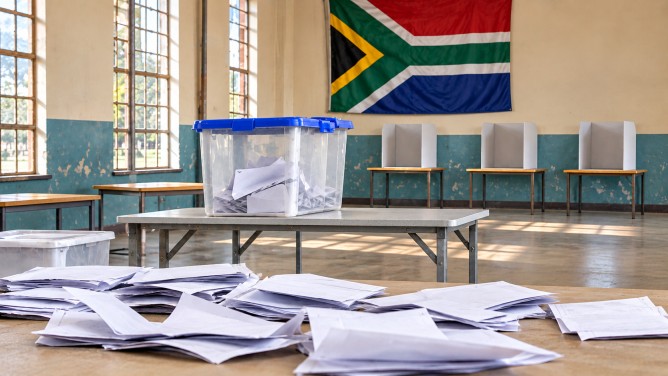
In South Africa’s 2026 Local Government Elections, the African National Congress (ANC) experienced a sharp decline in voter support, signaling a shift in the nation’s political landscape. The ANC garnered 9.16 million votes, a significant drop from the 10.69 million votes it received in 2021. This resulted in a decrease in its share of the national vote from 45.59% to 30.76%, although it remains the largest political party in the country.
The Democratic Alliance (DA) capitalized on this decline, boosting its vote count to 7.33 million from 5.07 million in the previous elections. The DA’s national vote share rose to 24.64%, further closing the gap with the ANC. Meanwhile, the newly participating uMkhonto weSizwe (MK) Party made a notable entrance by securing 2.91 million votes and capturing 9.77% of the national vote, positioning itself as the third-largest party.
Other political movements saw varied outcomes. The Economic Freedom Fighters (EFF) lost over 567,000 votes, totaling approximately 1.85 million, whereas ActionSA significantly increased its support, climbing from about 548,000 votes in 2021 to 1.69 million in 2026. The Inkatha Freedom Party, Freedom Front Plus, and Patriotic Alliance also recorded gains in this election cycle.
The election results have left 138 municipalities without clear majorities, highlighting the importance of coalition negotiations for forming local governments. The ANC will likely engage in discussions with other parties to maintain or gain control over several councils, as coalition governments are expected to play a critical role in municipal administration over the next five years.
This shift in political dynamics underscores the changing support patterns across South Africa, with opposition parties gaining ground and the political landscape becoming increasingly fragmented. The results of these elections suggest a growing trend towards coalition governance, reflecting a more diverse political representation at the local level.